Cold air pushing in under a door and a damp smell rising out of a crawl space are the same problem wearing two different coats: a gap that was never closed. Sorting out the types of weatherproofing starts with admitting that the products sold under that label do not do the same job. One is a flexible strip that presses into a gap around a door or window and stops air from moving. The other is a sheet of plastic that covers bare soil and slows moisture from evaporating up into the house. Buy the wrong one and it either peels off in January or tears underfoot in June. The measurements that decide it are simple ones, and almost nobody puts them in the listing headline.
Quick answer
Match the product to the gap, not to the season. For a door or window that leaks air, an adhesive-backed silicone strip that is wider than the gap is the right tool. For a crawl space with exposed soil, a polyethylene vapor barrier is the right tool, and the decision comes down to thickness in mils and roll length against the square footage you have to cover. Spec numbers printed on a listing are claims until the substrate cooperates, so measure the gap and the floor area first and buy second.
Five useful options
| Model | Best fit | What stands out |
|---|---|---|
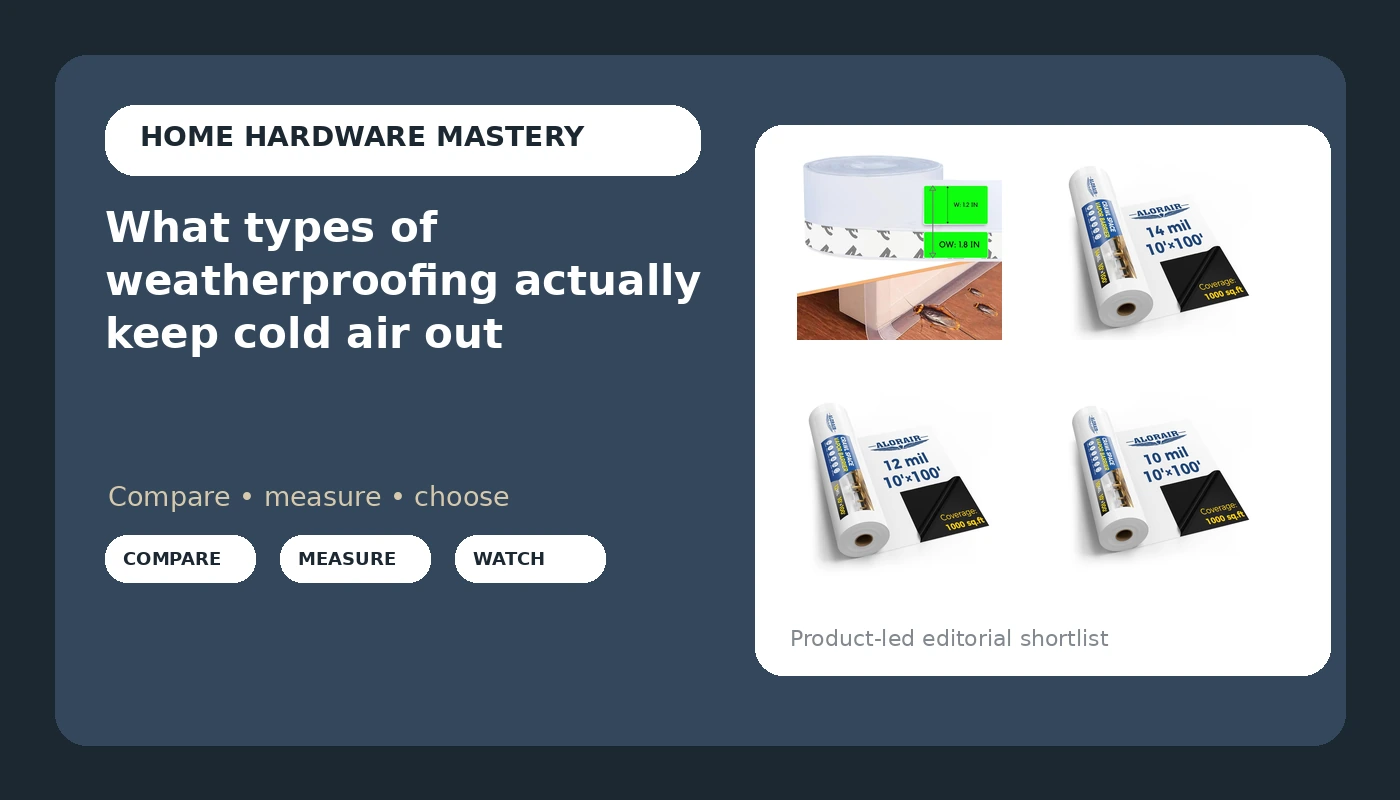
| Weather Stripping Door Seal 33ft Extra-Wide Silicone, Strong Adhesive, Seals Large Gaps for Maximum Winter Cold Protection and Weatherproofing, 1.8in Transparent | Door and window gaps too wide for standard foam tape | 33 ft roll, 1.8 in width, transparent silicone with adhesive backing |
| ALORAIR 14 mil Crawl Space Vapor Barrier 10' x 100' Plastic Sheeting | Crawl spaces with foot traffic or rough ground | Heaviest sheet in this group, 10 ft by 100 ft, about 1,000 sq ft |
| ALORAIR 12 mil Crawl Space Vapor Barrier 10' x 100' Plastic Sheeting | A middle weight for a full crawl space | 12 mil sheet at the same 10 ft by 100 ft coverage |
| ALORAIR 10 mil Crawl Space Vapor Barrier 10' x 100' Plastic Sheeting | Bare soil in a larger crawl space | 10 mil sheet, full 10 ft by 100 ft roll |
| ALORAIR 10 mil Crawl Space Vapor Barrier 10' x 50' Plastic Sheeting | Smaller crawl spaces where a full roll is waste | Same 10 mil sheet in a 10 ft by 50 ft roll |
Door and window gaps: Weather Stripping Door Seal 33ft Extra-Wide Silicone, Strong Adhesive, Seals Large Gaps for Maximum Winter Cold Protection and Weatherproofing, 1.8in Transparent
The trade-off here is width against clearance. A 1.8 inch strip covers more of a sloppy gap, but on a door that already drags on the jamb, that extra width is more surface to rub and roll. Measure the gap at the latch side, the hinge side, and the top, because a door that has sagged does not have one gap, it has three. The failure that shows up again and again with any adhesive-backed weatherstripping is the strip letting go at the first cold snap, and that is almost always a surface problem rather than a product problem: dust, oil, and a cold jamb all fight the adhesive. Wipe the frame with denatured alcohol, let it flash off completely, and apply when the frame is above the temperature range the manufacturer states.
Heavy ground cover: ALORAIR 14 mil Crawl Space Vapor Barrier 10' x 100' Plastic Sheeting
The case for the 14 mil sheet is mechanical, not magical. If you are going to be crawling across it every season to change a filter or look at a joist, a thicker sheet survives boots, dropped tools, and the odd chunk of rubble better than a thin one. The case against it is handling: a 100 foot roll of heavy polyethylene is awkward to drag through a 24 inch access hatch, and laps on a stiff sheet take more care to lay flat. If your crawl space is bare soil you visit once a year, the extra thickness is money spent on a problem you do not have.
Middle of the range: ALORAIR 12 mil Crawl Space Vapor Barrier 10' x 100' Plastic Sheeting
Where a mid-weight sheet earns its place is on ground that has been raked and cleared but is not perfectly smooth. It has enough body to bridge small irregularities without tearing at a lap, and it still folds over the foundation wall edge without fighting back the way a 14 mil sheet does. The trade-off is honest: less puncture resistance than the heavy roll, more than a 10 mil. If you are doing a weatherproofing comparison between these three thicknesses, the only question that changes the answer is what is going to be dragged across the sheet after it is down.
Standard full roll: ALORAIR 10 mil Crawl Space Vapor Barrier 10' x 100' Plastic Sheeting
This is the roll to buy when the space is going to be covered and then left alone. Ten mil handles being walked on carefully during the install and then not again. The limitation is the same one every thin sheet has: a sharp edge on a pier or a protruding form tie will find it. Knock down or cover anything sharp before you unroll, and run the sheet up the foundation wall a few inches rather than stopping it at the soil line, following whatever the manufacturer states for the product and the local inspector's guidance for the assembly.
Smaller crawl: ALORAIR 10 mil Crawl Space Vapor Barrier 10' x 50' Plastic Sheeting
The math on roll length is where most people overspend or come up short, and a weatherproofing size guide that skips this step is not much of a guide. Multiply the length by the width of the space, then add 10 to 15 percent for laps and cuts. A 50 foot roll covers a 10 by 50 strip in one piece; if your space is longer than that, you are lapping two pieces, and the lap is the part that has to be done right. A short roll is also easier to handle alone, which matters if you are doing this on a Saturday with no help.
Prices and availability may change. Product images, names, and retailer links must be matched by verified ASIN. Do not state a current price, rating, stock status, or measured result without current evidence.
How the main types of weatherproofing differ
The types of weatherproofing on a shelf fall into two families that get confused because they share a category. Air sealing stops movement of air: weatherstripping at a door jamb, a sweep at the bottom of a door, a compression strip in a window channel, a bead of sealant in a crack. Moisture control limits water vapor moving through a material: polyethylene sheeting over crawl space soil, a sill sealer under a bottom plate, a housewrap behind siding. They solve different problems, and no amount of extra thickness on one makes it do the other's job.
Within air sealing, the failure modes are predictable. Foam tape compresses and takes a set, so it seals for one season and then leaks. Adhesive-backed strips fail at the bond when the surface was not clean or the temperature was wrong. Sweeps wear at the leading edge where the floor is uneven. Within moisture control, the failure is usually mechanical: a puncture, a lap that was never taped, or a sheet that stops short of the wall. Thickness in mils is one thousandth of an inch, so 10 mil is ten thousandths, and the jump from 10 to 14 is a real difference in tear resistance rather than a marketing number.
Matching thickness and width to the job
This is how to choose weatherproofing without guessing, in the order the decisions actually come up.
- Measure the gap, not the door. Check the latch side, hinge side, top, and bottom separately, because a door that has settled does not have one uniform gap. The strip has to be wider than the widest gap it covers.
- Measure the crawl space floor in two directions and multiply. Add 10 to 15 percent for laps and cuts, then compare that number with the roll's stated square footage.
- Choose thickness by traffic. A space that is covered and left alone suits a 10 mil sheet. A space you crawl through regularly, or ground with rubble on it, is where a 12 or 14 mil sheet earns the extra handling weight.
- Check roll width against the span before you buy. A 10 ft wide roll covers a 10 ft span in one piece before laps, so anything wider means a second piece and a taped seam.
- Prep the surface. Adhesive needs clean, dry, and within the stated temperature range. Polyethylene needs the ground cleared of anything sharp. Neither step is optional, and both are where installs fail.
What to check before you buy
- Read the width and length first, the material second, and the photos last. A listing that leads with a lifestyle shot and buries 1.8 in and 33 ft is hiding the only numbers that matter.
- Treat a weatherproofing buying guide that opens with a star rating rather than a measurement as advertising. Weatherproofing reviews are useful for exactly one thing: the complaint that repeats. If the same failure shows up in review after review, that is the failure to plan around.
- Assume any adhesive strip will need a cleaned surface. Denatured alcohol on a lint-free rag, then let it dry. Applying over dust or a cold jamb is how a strip ends up on the floor in February.
- Keep laps to a minimum and tape the ones you cannot avoid, following the manufacturer's stated overlap. A loose lap on a ground sheet is a channel for moisture, which is the opposite of the point.
- For anyone new to this, weatherproofing for beginners comes down to two numbers: gap size and square footage. Get those right and the rest of the decision is thickness and handling.
- Store polyethylene out of sunlight before the install. UV degrades the sheet, and a roll that sat on a truck bed for a month is not the same roll.
Which option should you choose?
Choose the Weather Stripping Door Seal 33ft Extra-Wide Silicone, Strong Adhesive, Seals Large Gaps for Maximum Winter Cold Protection and Weatherproofing, 1.8in Transparent when the problem is air moving past a door or window and the gap is wider than a standard foam strip will bridge. Choose the ALORAIR 14 mil Crawl Space Vapor Barrier 10' x 100' Plastic Sheeting when the crawl space gets regular traffic or the ground is rough enough to threaten a thinner sheet. Choose the ALORAIR 12 mil Crawl Space Vapor Barrier 10' x 100' Plastic Sheeting when you want more tear resistance than a standard sheet without the handling weight of the heaviest roll. Choose the ALORAIR 10 mil Crawl Space Vapor Barrier 10' x 100' Plastic Sheeting when the space will be covered once and left alone and the footprint fits a full roll. Choose the ALORAIR 10 mil Crawl Space Vapor Barrier 10' x 50' Plastic Sheeting when the crawl space is small enough that a 100 foot roll means paying for waste.
This is a fit decision, not a ranking. None of these products has been lab tested here, no install times are being quoted, and no claim is made about performance beyond what the manufacturer states. On anything touching a foundation wall, a rim joist, or a required clearance, the local inspector's reading of the assembly governs, not a listing page.
The bottom line
The best budget weatherproofing is the one that matches the gap you actually have. A 1.8 inch silicone strip and a 10 mil ground sheet are both inexpensive ways to close a real opening, and buying either one in the wrong size wastes the money entirely. Measure the gap at three points, measure the floor in two directions, add for laps, and then pick thickness by how often you will be crawling over it. That gets you further than any list of top rated weatherproofing, because the rating was never about your door.